
By Vlad, Founder & SMP / Laser Tattoo Removal Specialist at Rico Clinic, Montréal. Last reviewed June 2026.
If you have booked your first laser tattoo removal appointment — or you are still deciding — the biggest source of anxiety is almost always the same: not knowing what is going to happen. What does the room look like? Does it hurt? How long does it take? What do you do afterward? I have personally performed more than 546 treatments here in Côte-des-Neiges since opening Rico Clinic in 2017, and over eight years and 135+ five-star Google reviews I have learned that a calm, well-prepared client has a far better experience than a surprised one. So let me walk you through exactly what a session looks like, start to finish, the same way I would across the consultation desk.

Before anything touches your skin: the numbing cream
A session almost always begins with numbing. Your technician applies a topical numbing cream over the tattoo and the skin immediately around it, then leaves it to work for 10 to 15 minutes. That waiting time is not wasted — it lets the cream actually penetrate the skin so the treatment is far more comfortable. Use those minutes to settle in, ask any last questions, and take a few slow breaths. There is no rush.
When the cream has done its job, your technician wipes the area clean. This step matters more than it looks: any residue, lotion, or debris left on the surface can sit between the laser and your skin and get in the way of a clean, even pass. A properly cleaned area means the energy goes exactly where it is supposed to go — into the ink.
Goggles, settings, and the first pass
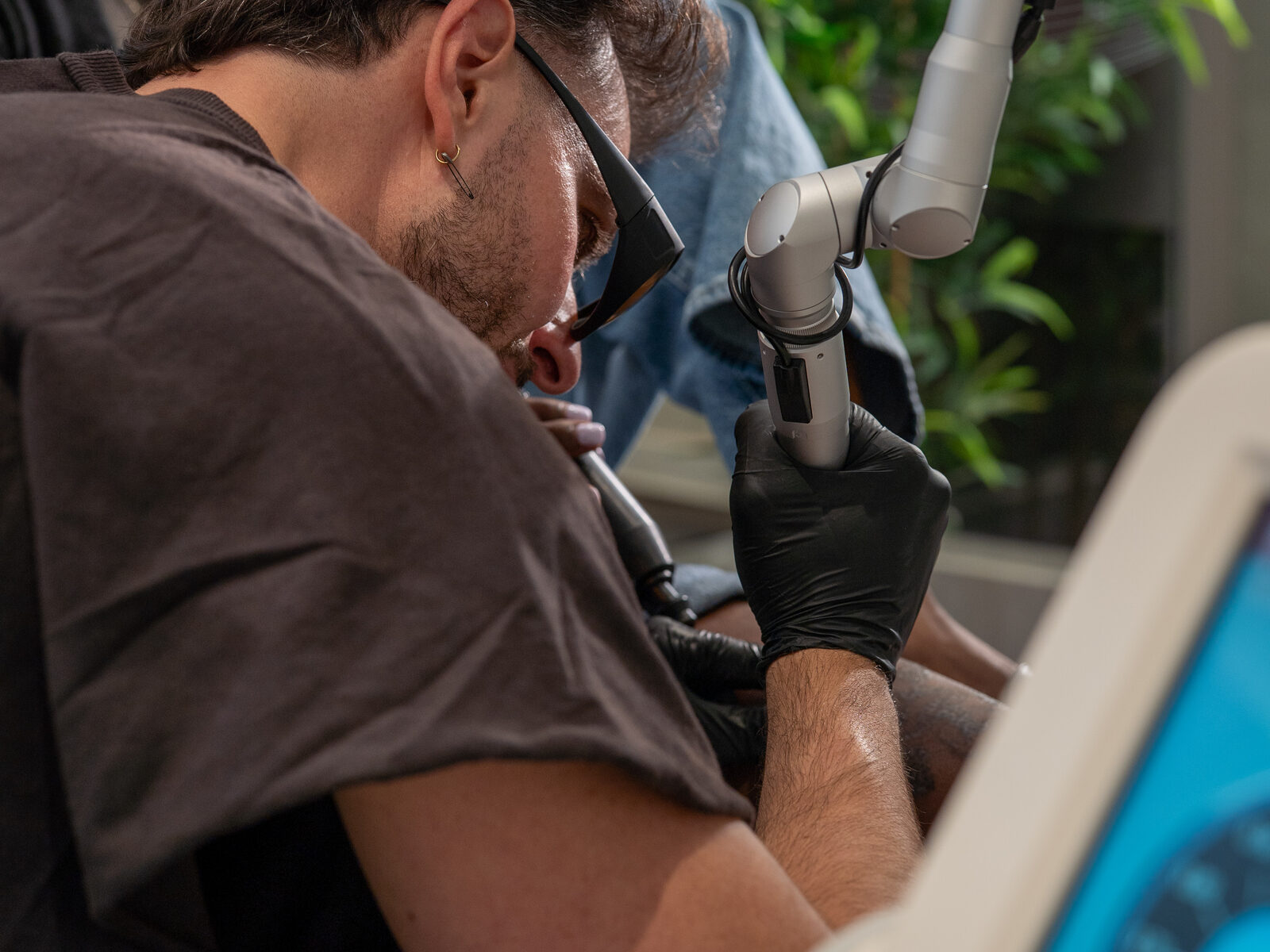
Next, you will be given protective goggles. These are not optional — laser light is intense, and shielding your eyes is non-negotiable for both you and your technician. Once your eyes are protected, your technician selects the right settings for your tattoo. The correct wavelength and speed depend on the colour and size of the ink: black and dark blues respond well to a 1064 nm wavelength, while reds and brighter pigments are targeted with 532 nm. There is no single setting that works for every tattoo, which is exactly why a personalized assessment comes first.
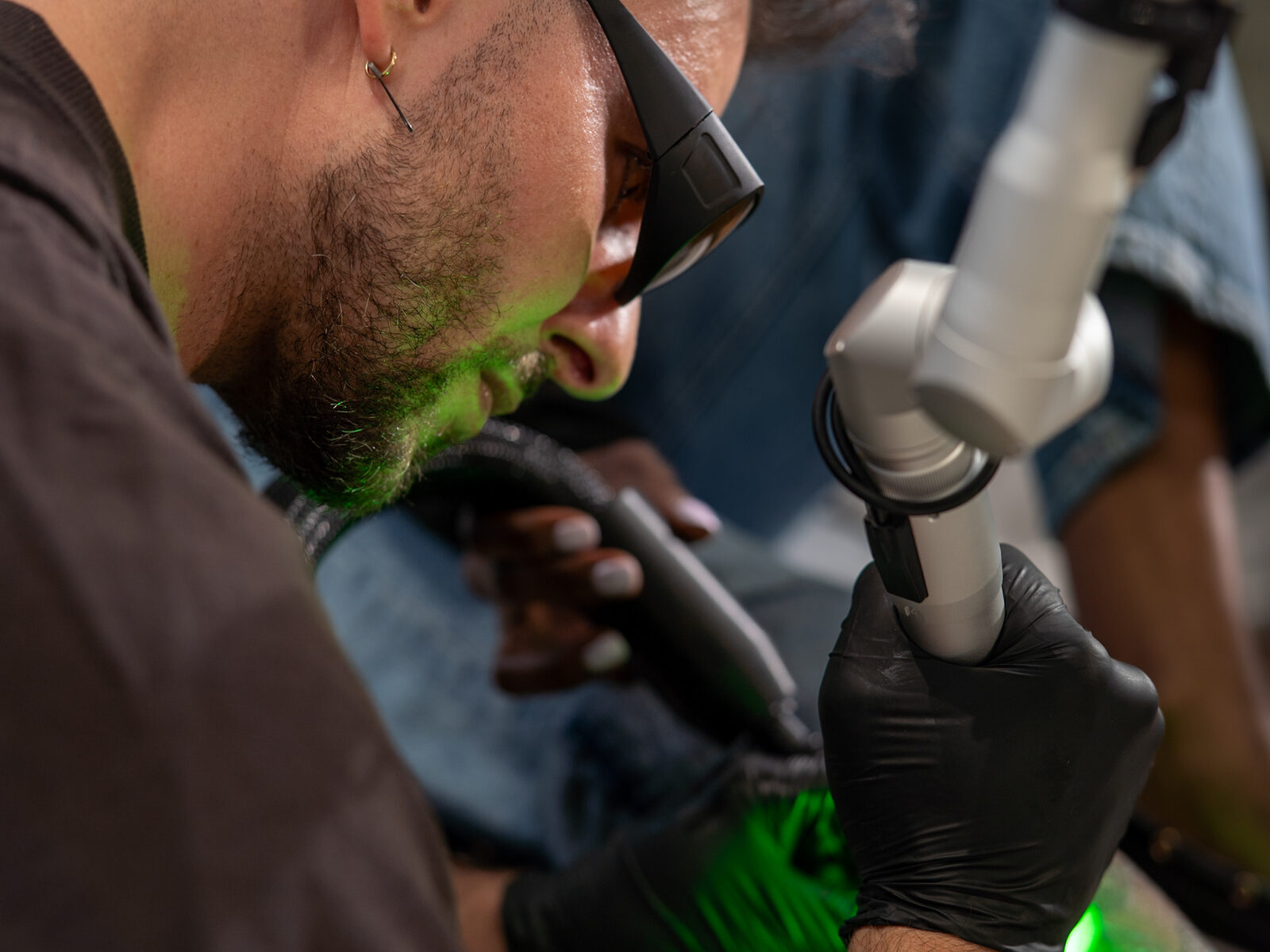
Then the laser is activated and the actual passes begin. The handpiece moves methodically across the tattoo, following the lines of the design. You will hear a rapid snapping or clicking sound and may notice a faint, almost firework-like greying of the ink as the pigment fractures — that is the laser doing its work.

The science, briefly — why the laser only targets the ink
It helps to understand why this works, because it explains almost everything about the experience. Modern laser tattoo removal relies on a principle called selective photothermolysis, first described by dermatologists Anderson and Parrish in 1983. The idea is that a very short, very precise pulse of light at the right wavelength is absorbed by the tattoo pigment specifically, shattering it into tiny fragments — without cooking the surrounding skin. Your body’s immune system then gradually carries those fragments away over the following weeks. That is also why removal happens over several sessions rather than all at once: each pass breaks down a portion of the ink, and your body needs time to clear it before the next round. You can read more about the technology and the full range of our work on our services overview.
What a session actually feels like
Let me be honest with you, because I would rather you trust me than be caught off guard. Most clients describe laser tattoo removal as moderately painful — often compared to the snap of an elastic band against the skin, or to a hot splatter. It is very manageable, especially with the numbing cream, but it is not nothing.
How much you feel depends a lot on where the tattoo is. Sensitive areas — the head, neck, ribs, ankles, the tops of the hands and feet — tend to feel sharper, because the skin is thinner and closer to bone. Fleshier areas like the arms, thighs, and shoulders are usually easier to sit through. Your technician will often take short breaks between passes to give you a moment to breathe and reset. There is no medal for powering through silently — tell us if you need a pause.
For larger or more sensitive tattoos, we may use a cold air blower directed at the skin during the passes. The cool stream meaningfully dulls the sensation and makes the session noticeably more comfortable. For smaller tattoos it is not always necessary, but it is there when it helps.
Why we will never rush your results
This is the single most important thing to understand, and I want to be very clear about it: a responsible technician will not crank up the laser intensity to remove your tattoo faster. Pushing the energy too high does not give you a quicker result — it gives you a burn, and potentially permanent scarring or changes in skin colour. Complete removal generally takes 6 to 12 sessions, spaced 6 to 8 weeks apart, and that spacing exists for a reason: your skin needs to heal and your body needs to clear the broken-down ink between visits. If anyone promises to erase a tattoo in one or two aggressive sessions, walk away. Slower and safe beats fast and damaged every single time.
The end of the session and your first hours
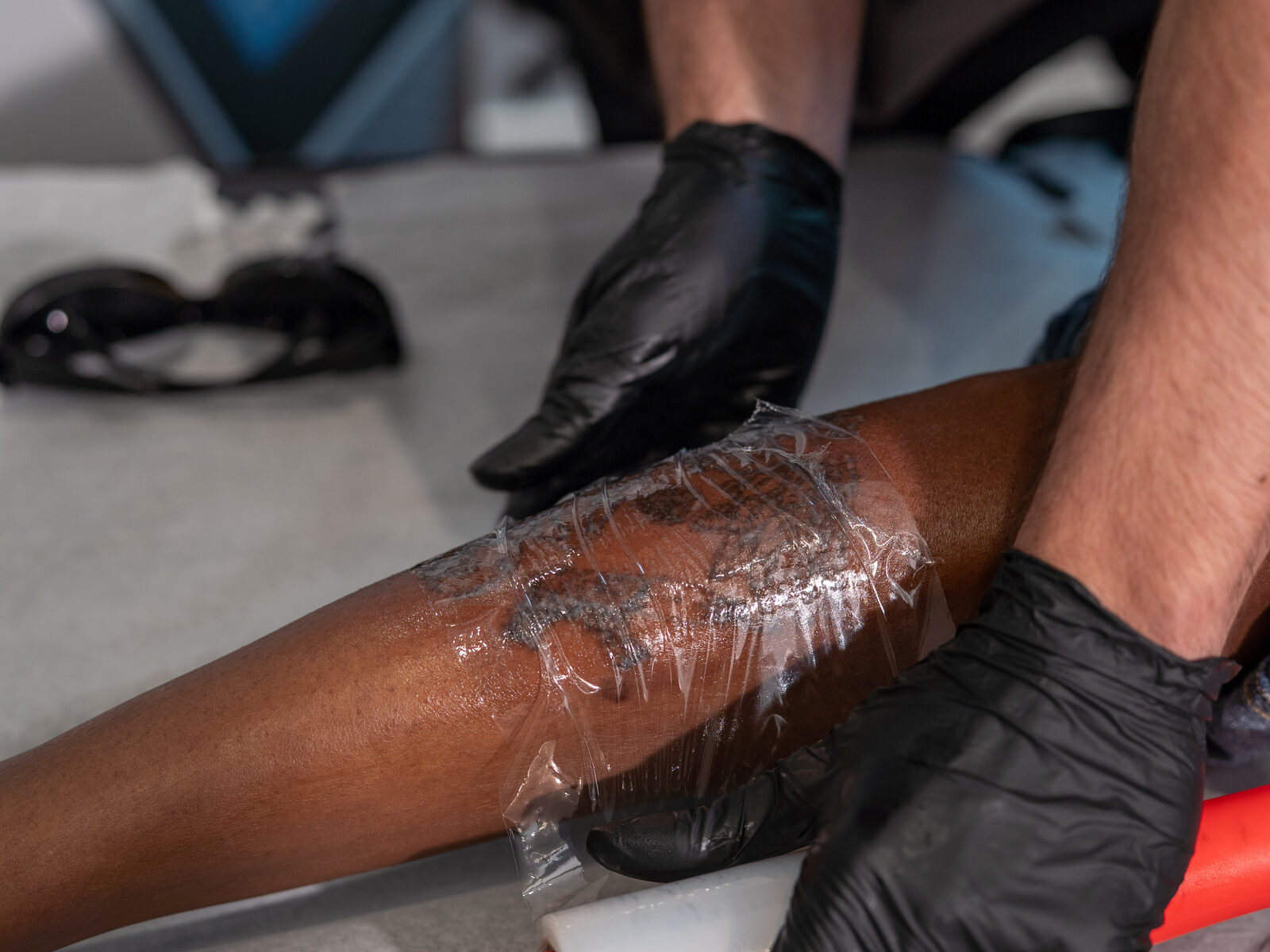
When the passes are done, your technician applies a healing cream to the treated area and will recommend you pick up a tube to keep using at home. The skin will likely look pink, slightly raised, and may form small blisters or a light scab over the next day or two — this is a normal part of healing, not a complication.
You are free to go straight back to your day. The clinic sits right on Chemin de la Côte-des-Neiges with street parking out front and Plamondon and Côte-Sainte-Catherine metro stations a short walk away, so getting home is easy.
Healing and aftercare, step by step
What you do over the next week genuinely affects your result. Here is the simple version:
- Days 1–7: Keep applying the healing cream as directed and keep the area clean and dry. If a blister forms, leave it alone — do not pop it.
- Do not pick or scratch any scabbing. Letting it fall off on its own protects the skin underneath and lowers any scarring risk.
- Stay hydrated. Your body is doing the work of flushing the ink — help it along with plenty of water.
- Avoid the sun. This is the big one. Keep the treated area out of direct sunlight until it has fully healed, and use sunscreen on it afterward. Sun exposure on healing skin is the most common cause of pigment problems.
- Skip the gym, sauna, pools, and hot tubs for the first few days while the skin closes up.
How many sessions you will need — and what it costs
Every tattoo is different. The number of sessions depends on the age of the ink, its colours, how deep and dense it was applied, your skin type, and the location on your body. As a rule, most tattoos take 6 to 12 sessions spaced 6 to 8 weeks apart. Per-session pricing at Rico Clinic ranges from $50 to $800 depending on the size and complexity of the tattoo, and multi-session packages bring the per-visit cost down. The honest answer to “how much and how long for mine?” comes from a look in person — which is exactly what the free consultation is for.
Frequently Asked Questions
Does laser tattoo removal hurt?
Most people find it moderately painful — similar to the snap of an elastic band. Numbing cream is applied beforehand, and we can use a cold air blower during the session to take the edge off. Sensitive spots like the neck, ribs, and ankles feel sharper than fleshier areas like the arm or thigh, and we take breaks whenever you need one.
How long does a single session take?
The numbing cream needs 10 to 15 minutes to take effect first. The laser passes themselves are usually quick — often just a few minutes for a small-to-medium tattoo — so most appointments are comfortably under an hour from start to finish. Larger pieces take a little longer.
How many sessions will I need to remove my tattoo completely?
Most tattoos need 6 to 12 sessions, spaced 6 to 8 weeks apart so your skin can heal and your body can clear the broken-down ink between visits. Older, faded, black-ink tattoos often clear faster; dense, colourful, or recent ones take more sessions. We give you a realistic estimate at your free consultation.
Will laser tattoo removal leave a scar?
When the laser is used correctly and you follow aftercare, scarring is uncommon. The biggest risks come from over-aggressive settings or from picking at scabs and blisters during healing. We deliberately use safe, appropriate energy levels and never rush your results, which is the best protection your skin can have.
What should I do right after my session?
Keep applying the healing cream, leave any blisters or scabs alone, stay hydrated, and — most importantly — keep the area out of the sun until it is fully healed. Avoid pools, saunas, and intense workouts for the first few days. Full day-by-day guidance is above.
How much does laser tattoo removal cost in Montréal?
At Rico Clinic, sessions range from $50 to $800 depending on the size and complexity of the tattoo, with packages available for multi-session plans. Your free consultation includes a personalized quote so there are no surprises.
What our clients say
Since 2017 we have completed 546+ treatments and earned 135+ Google reviews at a 5.0 rating. Clients consistently mention two things: that the process was calmer and less painful than they feared, and that we never pressured them or over-promised. That reputation is built one careful session at a time — and it is exactly the experience we want you to have. You can read more of our articles on tattoo removal over on the Rico Clinic blog.
Book your free consultation
The best way to know what your own tattoo will need is to come in and let us look. Your consultation is free, honest, and no-pressure — we will assess your ink, explain your options, and give you a real timeline and quote.
Book your free consultation online, or call us at (514) 346-8044. We are at 4934 Chemin de la Côte-des-Neiges, Montréal, open Monday to Friday, 9 AM to 6 PM.
I wish you a smooth, successful tattoo removal journey.
— Vlad, Founder & SMP / Laser Tattoo Removal Specialist, Rico Clinic. Last reviewed June 2026.