
Last reviewed June 2025 by Vlad, Founder & SMP / Laser Tattoo Removal Specialist at Rico Clinic, Montréal.

If you have dark or Black skin and you’ve been told tattoo removal isn’t really an option for you, I want you to read this carefully. It absolutely is an option. But it’s also true that removing a tattoo from skin with more melanin asks more of the person holding the laser. It takes patience, conservative settings, and a technician who understands exactly how the light interacts with your skin. At Rico Clinic, we’ve been doing this work in Montréal since 2017, with 546+ treatments behind us and a 5.0 rating across 135+ Google reviews. This article walks you through what makes dark-skin removal different, and how a careful, personalized approach keeps your skin safe while the ink fades.
Why dark and Black skin needs a different approach
Laser tattoo removal works by sending very short pulses of light into the skin. That light is absorbed by the tattoo pigment, which shatters the ink into tiny particles your immune system can carry away over the following weeks. The science behind this — selective photothermolysis — was first described by Anderson and Parrish in 1983, and it’s still the principle every reputable clinic relies on today.
Here’s the catch for darker skin: the same melanin that gives your skin its tone can also absorb laser light. If the laser targets the melanin in your skin instead of staying focused on the tattoo ink, you can end up with unintended damage — hyperpigmentation (dark patches), hypopigmentation (light patches), or, in the worst cases, scarring. That’s the real risk, and it’s why a one-size-fits-all approach is dangerous on dark skin. The energy that’s perfectly safe on very pale skin can be too much for skin with more melanin.
The solution isn’t to avoid treatment — it’s to treat smarter. On dark and Black skin, we deliberately use lower laser energy than we would on lighter tones, choose wavelengths that are better tolerated by melanin-rich skin, and we go slowly, especially at the start.

Conservative laser settings come first
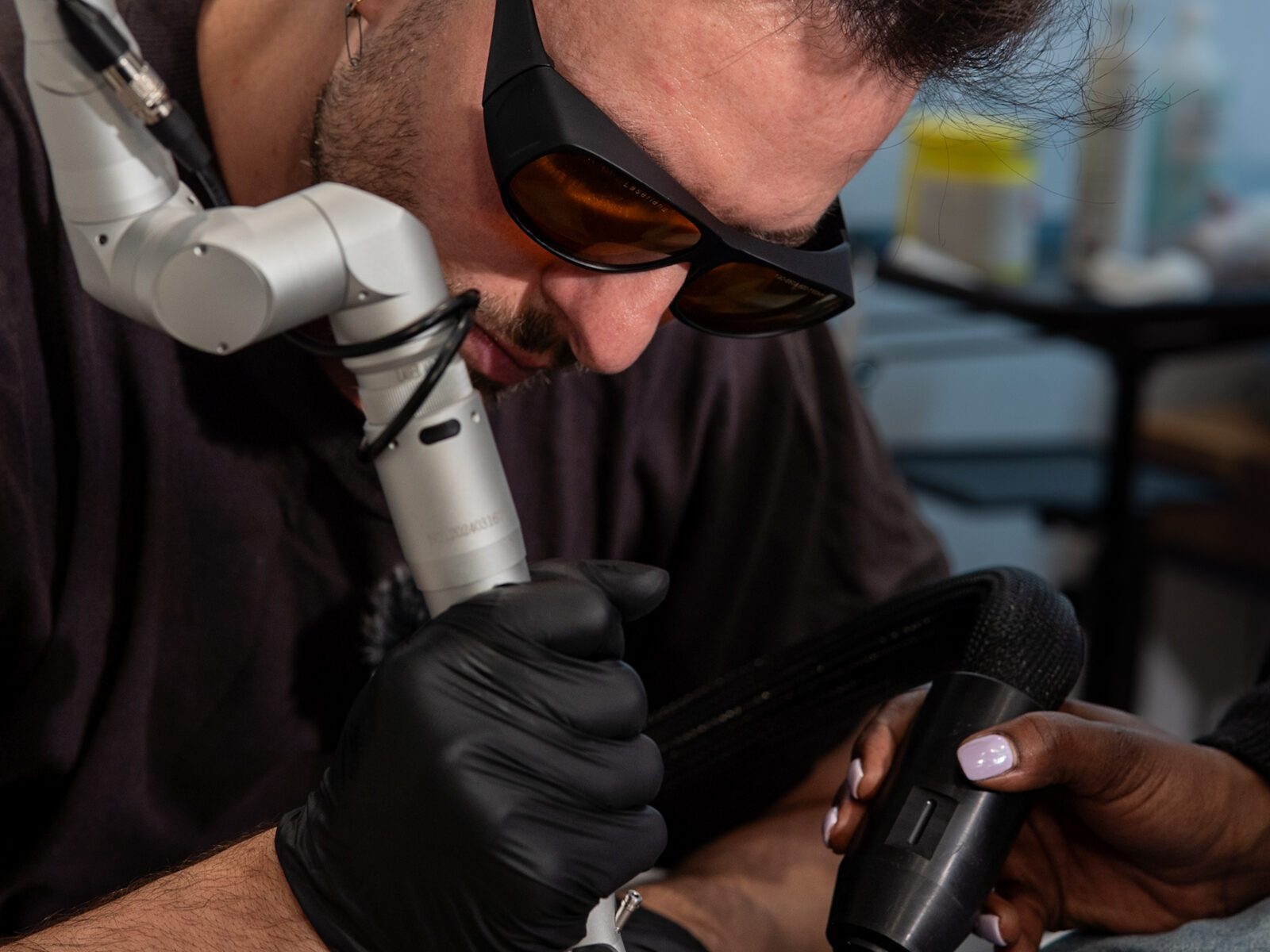
When we treat dark or Black skin, reduced energy is non-negotiable. I know it can be tempting to ask us to “turn it up” so the tattoo disappears faster — almost everyone does at some point. But on melanin-rich skin, pushing the intensity is exactly how you get burns, blistering, and lasting pigment changes. A good technician will respectfully say no to that request, and you should be wary of anyone who says yes.
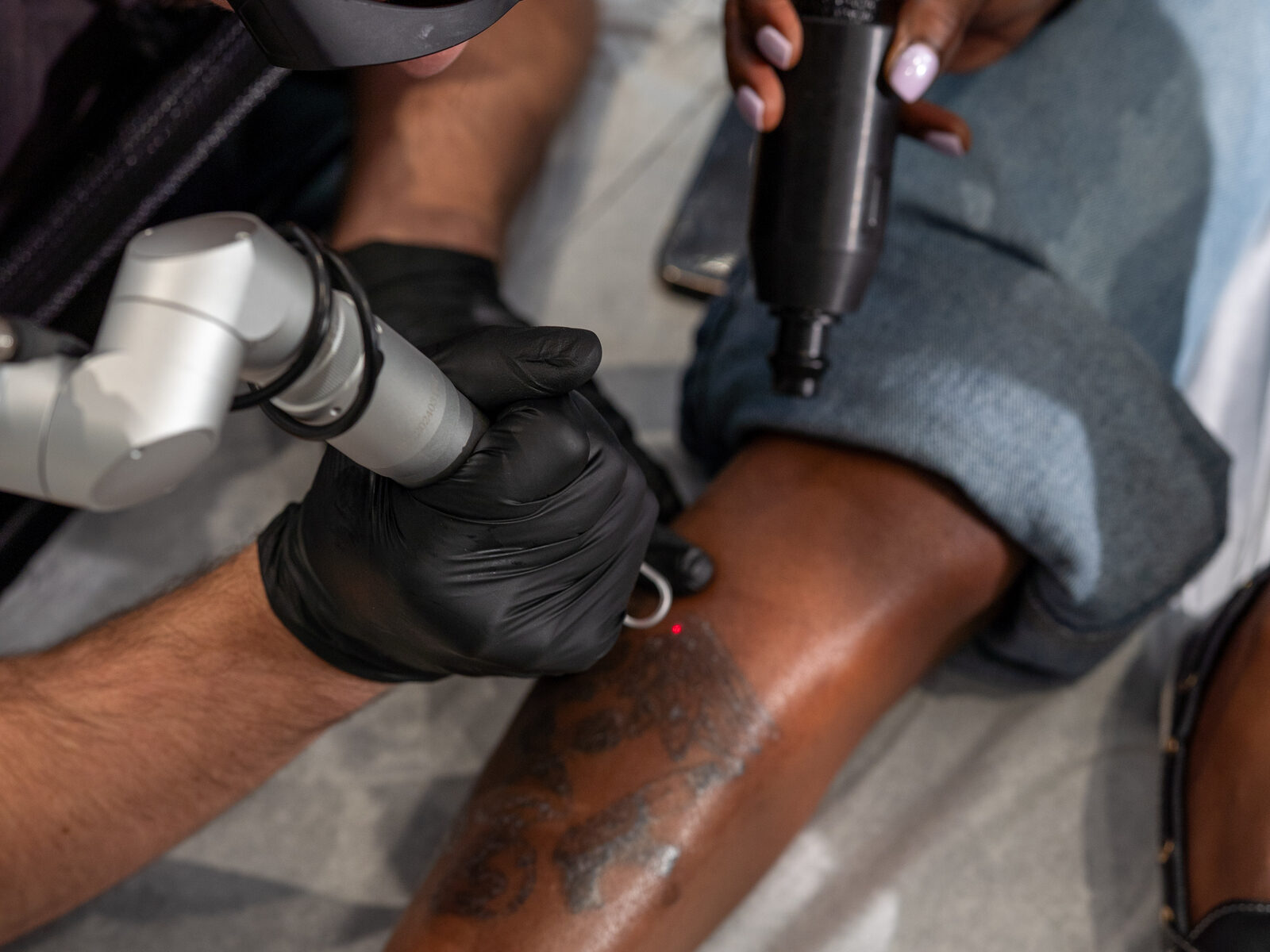
Your first session is intentionally the most cautious. We use it to read how your skin responds before we commit to a full course. The wavelength matters too: the 1064 nm setting tends to be the safer workhorse for darker skin because it’s less drawn to melanin, while shorter wavelengths like 532 nm — useful for certain ink colours — are used much more carefully. Throughout the session, the technician follows the lines of your tattoo precisely and avoids passing the laser over bare, untattooed skin, so we’re not exposing your skin to energy it doesn’t need.
Why we spot-test colourful tattoos
Coloured ink — greens, reds, blues, and other vibrant pigments — is harder to remove than plain black, and on darker skin it deserves extra care. Different colours respond to different wavelengths, and we can’t always predict exactly how your skin will react to a given setting.
That’s why, for colourful work, we often do a spot test first: we treat a small area, no bigger than about half an inch square, using the wavelength suited to that ink colour. Then we wait three days and watch. If your skin handles it well — no swelling, no blistering, no broken skin — we know it’s safe to treat the rest of the tattoo. If there’s an adverse reaction, we’ve learned that on a tiny, easily-managed patch instead of across your whole tattoo. It costs a few days of patience and saves you from a result you’d regret.
A personalized approach, every time
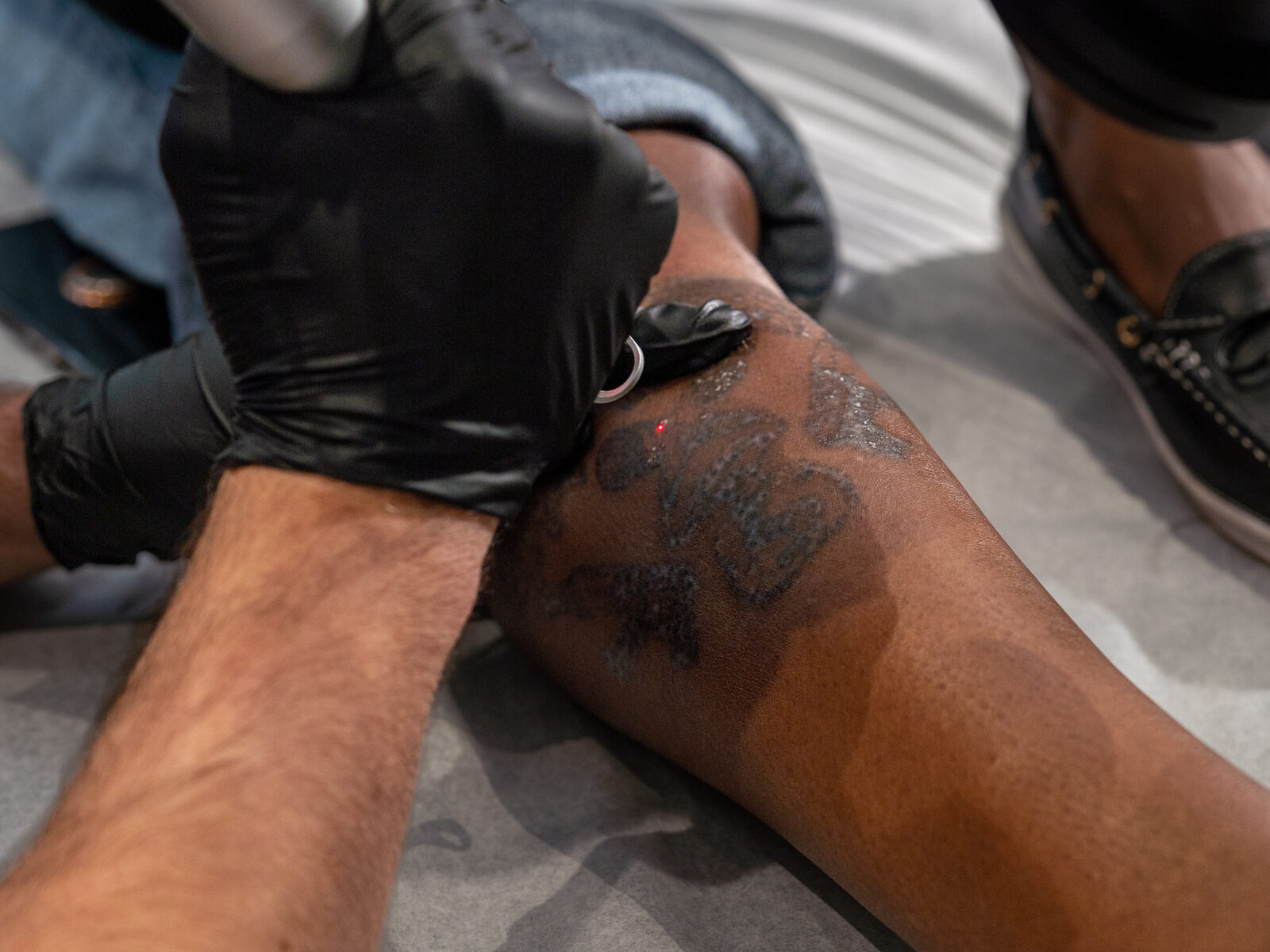
No two people’s skin behaves identically. Even with careful technique, skin can react in unexpected ways, which is why we treat every client as their own case rather than running a fixed protocol. We assess your skin tone, your tattoo’s age, ink colours and depth, and your medical history before we choose a single setting.
If you ever notice a strong reaction after a session — significant swelling, blistering, broken skin, or anything that worries you — don’t wait it out. Contact us, and if it’s severe, seek medical attention promptly. These reactions are uncommon when treatment is done conservatively, but knowing what to watch for is part of being an informed client. You can read more about what a typical appointment involves in our guide to what happens during a laser tattoo removal session, and explore all of our treatment options if you’re weighing your choices.
What a session actually feels like
Most people describe laser tattoo removal as moderately uncomfortable rather than unbearable — many compare it to the snap of an elastic band against the skin. Sensitive areas like the head, neck, hands and feet tend to sting more than the arms or thighs. We apply a numbing cream beforehand and can use a cold-air blower during the session to take the edge off, and we’ll pause between passes whenever you need a breath. The treatment itself is usually quick; smaller tattoos can be done in just a few minutes of actual laser time.
Healing and aftercare
Aftercare matters even more on dark skin, because good healing helps prevent the pigment changes we work so hard to avoid. At the end of each session we apply a healing ointment, and we’ll recommend you keep applying it for about a week. Keep the area clean and moisturized, don’t pick at any scabs or blisters, and stay hydrated. The single most important rule: keep the treated skin out of the sun until it has fully healed, and use sunscreen on it afterward. Sun exposure on healing skin is one of the biggest drivers of unwanted pigmentation, so this step is not optional.
How many sessions and what it costs
Tattoo removal is a gradual process — your body needs time to clear the shattered ink between sessions. Most tattoos take somewhere between 6 and 12 sessions to fully remove, spaced roughly 6 to 8 weeks apart. On darker skin we sometimes space sessions a little further and keep energy conservative, which can add to the timeline but protects your skin. At Rico Clinic, individual sessions run from $50 to $800 depending on the size, colours, and complexity of your tattoo, and we offer multi-session packages that bring the per-session cost down. Your free consultation is where we map all of this out for your specific tattoo — no surprises.
Frequently Asked Questions
Is laser tattoo removal safe on dark or Black skin?
Yes, when it’s done correctly. The key is using lower laser energy, melanin-friendly wavelengths like 1064 nm, conservative first sessions, and spot tests for coloured ink. Done this way, removal is safe and effective on darker skin. The risk comes from technicians who treat dark skin the same as light skin or push the intensity too high.
Will tattoo removal cause hyperpigmentation or lighten my skin?
Pigment changes — darker or lighter patches — are the main risk on dark skin, but they’re largely preventable. Conservative settings, careful wavelength choice, spot testing, and strict sun protection during healing dramatically reduce the chance. Most pigment changes that do occur are temporary and fade over time when the skin is cared for properly.
How many sessions will I need?
Most tattoos take 6 to 12 sessions, spaced 6 to 8 weeks apart so your body can clear the ink between visits. Coloured tattoos and those on darker skin sometimes need a more patient pace. We give you a personalized estimate at your free consultation.
Does it hurt?
It’s moderately uncomfortable — often likened to an elastic band snapping against the skin. We use numbing cream and a cold-air blower to keep you comfortable, and sensitive spots like the head and neck feel it more than the arms or legs.
How much does it cost?
Sessions range from $50 to $800 depending on your tattoo’s size, colour, and complexity. Multi-session packages lower the per-session price. You’ll get an exact, personalized quote at your free consultation.
What our clients say
We’re proud to have earned a 5.0 rating across 135+ Google reviews from clients all over Montréal. People consistently mention our professionalism, our warm and unhurried approach, and the visible results they’ve seen. For clients with darker skin in particular, that careful, conservative method is exactly why they trust us with their skin.
Book your free consultation
If you have dark or Black skin and you’ve been putting off tattoo removal because you weren’t sure it could be done safely, let’s talk. Your consultation is free, honest, and pressure-free — we’ll look at your tattoo, explain what to expect, and give you a clear plan. Book your free consultation online, or call us at (514) 346-8044. We’re at 4934 Chemin de la Côte-des-Neiges in Montréal, open Monday to Friday, 9 AM to 6 PM. You can also browse more articles on our blog.
Reviewed by Vlad, Founder & SMP / Laser Tattoo Removal Specialist, Rico Clinic. Last reviewed June 2025.